If you’re running a residential solar EPC in Florida doing anywhere from 5 to 30 installs a month, you know exactly what Monday morning looks like.
You sit down, open your laptop, and start the "shakedown." You’re chasing a homeowner in Cape Coral who hasn't sent their utility bill. You’re checking the FPL portal for the third time this morning to see if an interconnection application moved an inch. You’ve got a permit rejection from an AHJ in Hillsborough County because the structural calc format was “wrong” (even though it’s the same one they approved last week).
For most owners, this is just "the business." You hire more people to handle the paperwork, and suddenly you’re managing a four-person operations team that costs you $200,000 a year just to keep the lights on and the jobs moving. If that sounds familiar, The Hidden Cost of Running Solar Operations Manually breaks down exactly where those team costs pile up.
But there’s a shift happening. A few months ago, a Florida EPC owner : let’s call him Mike : decided he was done being the bottleneck. He stopped looking for another "Permit Coordinator" and started looking for a solar operations system that didn't need a lunch break.
Here is the true story of what happens when you stop throwing humans at manual problems and start putting AI agents on the job.
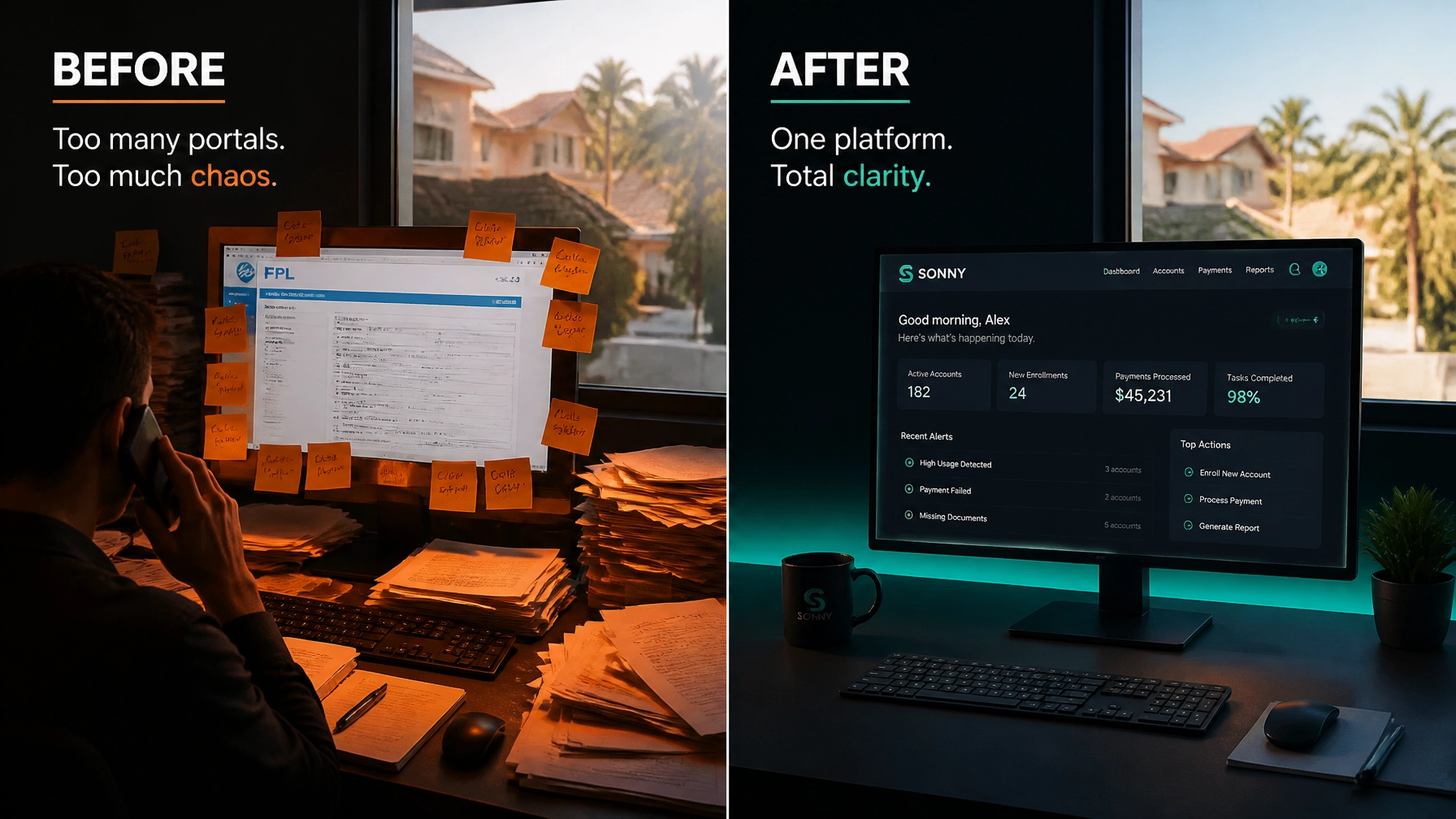
The "Before": A Pipeline Held Together by Sticky Notes and Hope
Before Mike migrated to an AI-powered system, his operation was a classic Florida grind. If you’ve seen Why Your Solar Operations Are Still Stuck in 2019, you already know the pattern: too many manual handoffs, too much follow-up, and no real system holding it together. He had 22 jobs in the pipeline. On paper, that’s great revenue. In reality, it was a liability.
- The Document Chase: Mike’s project manager spent 40% of her day texting homeowners for signed contracts, utility bills, and HOA approvals. If she forgot to follow up, the job sat.
- The Permitting Black Hole: Every AHJ in Florida has its own "flavor." Some love SolarAPP+, others want a manual PDF upload with specific naming conventions. One mistake meant a 2-week delay.
- The PTO Gap: Jobs were getting installed, but they weren't getting turned on. The gap between "Install Day" and "Permission to Operate" (PTO) was stretching to 45 days. That’s 45 days of a pissed-off homeowner and 45 days Mike couldn't collect his final milestone payment. It’s the exact kind of delay covered in Jobs Installed, System Off, where the PTO gap becomes a cash flow problem fast.
Mike was working 70 hours a week just to make sure things didn't fall through the cracks. He was the "Chief Firefighter."

Enter the AI Agents: The 24/7 Crew
Mike didn't just buy software; he built a machine. He migrated his entire operation to JobTread paired with DATAx AI agents. Here is how the workflow changed on Day 1.
1. The Document Agent (The "Polite Nag")
The moment a lead was marked "Closed-Won," the AI agent took over. It didn't wait for a human to get back from lunch. Within 60 seconds, it sent a personalized link to the homeowner to upload their latest utility bill and sign the HOA disclosure.
If the homeowner didn't respond? The AI didn't forget. It sent a friendly nudge at 6 PM on Tuesday (when people are actually home) and another on Saturday morning. Mike’s team didn't have to send a single "just checking in" text. The documents just… appeared in the job folder.
2. The Permitting Agent (Navigating the AHJ Maze)
Florida solar permits are a nightmare because every city plays by different rules. Mike’s new system used an AI agent that "knows" the requirements for over 400 Florida AHJs.
When it was time to submit, the agent checked the plan set against NEC 2023 and Florida Building Code standards. If it detected a common rejection reason : like a missing PE stamp on a structural letter or a labeling error : it flagged it before submission. For cities using SolarAPP+, it auto-filled the data, cutting the "Permit Prep" time from 3 hours to 15 minutes.
3. The Interconnection Agent (The Utility Portal Specialist)
This is where Mike was losing the most money. FPL, Duke, and TECO portals are where solar jobs go to die.
The AI agent was programmed to log in, check status, and scrape updates every 24 hours. The moment an FPL interconnection application was flagged for a "missing signature," the AI didn't wait for Mike to see the email. It automatically generated the required form, sent it to the homeowner via DocuSign, and notified the team.
The result? The gap between install and PTO dropped from 45 days to 14 days.

The "After": From Chaos to a Machine
Three months after putting AI agents on his jobs, Mike’s business looked unrecognizable:
- Fixed Costs Dropped: He didn't need to hire that fifth operations person. In fact, his existing team of two was now handling triple the volume because they weren't doing data entry; they were just handling the "exceptions" the AI flagged.
- Cash Flow Exploded: By shaving 30 days off the PTO timeline, Mike was pulling in final payments $150,000 faster every single month.
- The "Owner's Life" Returned: Mike stopped checking FPL portals at 9 PM on Sundays. He had a dashboard that showed him exactly where every job stood. Green meant the AI was handling it. Red meant a human needed to step in. There were very few red dots.
Why Most Florida EPCs Are Still Doing It Wrong
Most owners think "AI" is for Silicon Valley tech companies. They think a solar operations system is just a CRM where you store phone numbers.
But in 2026, the complexity of Florida solar permits and utility requirements has outpaced human memory. If you are still relying on a person to remember to check a portal or follow up with a homeowner, you are leaving 2-3 points of margin on the table in "operational friction" alone. And with policy pressure increasing, Florida Net Metering Rates Are Dropping is one more reason speed now matters more than ever.
The "Achieve Solar" story isn't an outlier. It’s the new baseline for anyone doing 10+ installs a month in the Sunshine State. The "manual" era of solar is over. You can either keep hiring more people to manage the mess, or you can build a machine that runs without you.
Is Your Operation Ready for the Shift?
If you’re tired of the "black hole" between contract and PTO, it’s time to stop being the bottleneck. At GridReady, we build and deploy the exact AI-powered system Mike used. We don't just give you software; we give you a fully automated operation in 5-7 business days.
Stop chasing documents. Start scaling your business.
Ready to see the machine in action?
Visit gridreadyops.com to book a demo of the AI-powered solar workflow.
Leave a Reply